


Edito & visual Identity
Nuits sonores has always been a space for experimentation, freedom and celebration - a unifying project that resists polarisation, and a committed event that aims to have a positive impact on society rather than simply remain an observer.
For twenty-three editions, Nuits sonores has defended independence. Long associated with artistic quality and avant-garde spirit, independence now stands for freedom, emancipation, and social choice—values that resonate strongly in a world threatened by the rise of the extreme right and the concentration of ownership in the music and media industries.
For the 2026 edition, we turn our attention to independence—its positive, vital, and deeply desirable values, embracing them with passion and conviction. Our aim is to defend an independent model rather than denounce others, and to joyfully inspire support rather than division.
Today, being an independent festival means having the freedom to make our own choices. It means defining the line between our cultural and artistic
directions and economic models that make them possible. Independence means the ability to create human-scale projects within agile ecosystems, in
close dialogue with local communities. It means identifying and supporting emerging artists, fostering positive initiatives, experimenting with original formats, and continually learning by trying - and trying again. But this comes at a cost. True independence also means embracing the inherent fragility of this model, standing without a safety net. The current state of festivals, both locally and internationally, urgently reminds us of the need to act now and defend who we are.
Attending Nuits sonores is a way to offer concrete support to a festival that continues to take risks and navigate the music industry, despite constant pressure on its artistic, technical, and security budgets. It’s also supporting the work of a team that, year-round, is committed to forging its own path despite fierce competition from major groups, while maintaining a thoughtful and fair approach to programming.
Since 2003, Nuits sonores has been run by Arty Farty. The festival quickly became a platform for cutting-edge programming in Lyon, our hometown, offering an experience that is constantly refreshed. We can’t wait for this year’s edition to reconnect with our audience, artists, speakers, and everyone
who works tirelessly to make the 23rd edition happen.
Every year, Nuits sonores maps out new soundscapes, revealing ever-changing aesthetics, where the history of electronic music constantly dialogues with its contemporary reinventions. The Nuits sonores programme offers the public a journey through these constantly changing landscapes: from founding mythologies to future revelations, from club culture to raves, from urban dancefloors to sound systems around the world. By bringing together historical figures, emerging artists, local talent and international avant-garde artists, the festival affirms an open and political vision of music, attentive to social, geographical and aesthetic contexts.
A FESTIVAL WHERE GEOPOLITICS IS AS MUCH A SUBJECT FOR THOUGHT AS IT IS FOR DANCING
When borders harden, the dance floor remains a common territory: a place where music becomes one with the world, where geopolitics is as much danced to as it is thought about. More political than ever, Nuits sonores opens with a live performance by Ukrainian artists Heinali & Andriana-Yaroslava Saienko and their project Гільдеґарда, which explores the embodied intensity of Hildegard’s music, the physical demands of her singing and its spiritual depth “as a prism through which to navigate the traumas of war, a way to endure and overcome collective pain .” The festival closes with Sama’ Abdulhadi, an international figure in techno and an essential voice in the Palestinian electronic music scene.
FROM FOUNDING MYTHOLOGIES TO FUTURE REVELATIONS
This edition also illustrates the interplay between generations, an essential thread running through Nuits Sonores’ identity, as the historical narratives of our music are the very foundations of its reinvention. The exceptional invitation extended to 808 State embodies this living relationship with our origins. Formed in Manchester in the late 1980s, the group, one of the founders of British acid house and author of the legendary Pacific State, helped to popularise this genre in the United Kingdom, exerting a lasting influence on bands such as Underworld and Orbital. In the same vein, The Sabres of Paradise embodies the British warehouse era of the early 1990s, a pivotal moment that saw the emergence of dark, melodic and radically club-oriented electronica. The duo Leftfield continues this narrative from a different angle, opening up a new space between club culture and more pop/rock formats, fusing house, dub, breakbeat and socially conscious vocals. The album Leftism remains a milestone in electronic crossover, influencing both the alternative scene and the dancefloors. Their meeting at the festival in B2B with HAAi, a figure of the British club revival who moved from postrock to DJing, creates a direct bridge between the heritage and reinvention of UK bass. In keeping with this spirit of sharing and collaboration, the festival is staging some unique duos: techno figure Rødhåd facing off against Tauceti, a pillar of the Lyon scene, and Vel, resident DJ at Le Sucre, in her first B2B dialogue with Anetha, international star and founder of the Mama Told Ya label, to MCR-T from the Live From Earth collective and the iconic Grenoble artist KITTIN, who will also share the booth for a special ‘decks & mics’ set with wellcrafted rhymes.
LEGACY, LOYALTY AND REINVENTION
In this historical vein, Juan Atkins’ return takes centre stage. Already present in 2019 with his Model 500 project, he returns this time with a DJ set. A founding figure of Detroit techno with The Belleville Three, Juan Atkins was one of the first to formalise the term ‘techno’ itself with, in 1984, the track Techno City by Cybotron (his project with Richard Davis), which brought the word into the musical vocabulary, before its international recognition with the compilation Techno! The New Dance Sound of Detroit in 1988.
Some artists inevitably return to mark their evolution and trajectory in the festival’s history. After creating a memorable Day With in 2018, Four Tet (Kieran Hebden) finally returns to Nuits sonores. A major artist for nearly thirty years, he has developed a unique body of work combining popular music and experimentation, folk, ambient and electronica. His ability to navigate between intimate live performances and large gatherings, alongside Skrillex and Fred Again, illustrates an open-minded vision of electronic music that is faithful to that of Nuits sonores. Amelie Lens, a regular at the festival, has continued her meteoric rise since 2016, establishing herself as a central figure in contemporary techno, combining industrial rigour with unifying energy. Brazilian star Mochakk is also back, following a memorable appearance last year, this time curating a line-up that links the history of house music to the current vitality of the Brazilian scene.
A LIVING MAP OF GLOBAL SOUND CULTURES
This year, Nuits sonores is placing particular emphasis on the connections between lowfrequency music, sound system cultures and their global circulation. Mad Professor perfectly embodies this Caribbean-UK axis: a pioneer in tape manipulation, spatialisation and reverberation, he has brought dub into pop and experimental crossovers. The duo Baalti reveals the still littleknown sound system scene of West Bengal, while the energy of South African gqom, which originated in Durban in the early 2010s, is embodied by Azyoman (from the Bridges for Music school) or the explosive dialogue between Scratchclart & Darkman Zulu (a veteran of London grime and pioneer of gqom), as well as Nazar, whose music, deeply marked by the memory of the Angolan civil war and the violence of a repressive state, blends kuduro, gqom and industrial textures. The exploration continues with Edna Martinez, focusing on picos, the customised, ultra-colourful loudspeakers of the voiceless, which have become a point of resistance at popular festivals on the Colombian coast. Bclip has also developed a hybrid sound combining reggaeton, rap and experimentation, before establishing himself in Bogotà. as an avant-garde artist and activist on the queer scene. Alongside them on the festival programme, a plurality of representations of aesthetic changes from South America - from MuaaK’s Latin core to Lila Sky’s neoperreo, via DJ Baba the Raptor, a figure of Venezuelan raptor house and an essential artist of Changa tuki (a set of local sub-genres, a scene that is all the more endangered given the country’s current political context) – extending this living map of global sound cultures.
The festival’s aesthetic openness is also reflected in its promotion of new jazz and psychedelic variations: Lyon-based artist Vannye and his band, local project SHIBUUYA!, and Nova Fellowship, a new creation for Nuits sonores paying tribute to the duo Kieran Hebden & Steve Reid, embrace the encounter between improvised jazz and electronic rhythms. Emma-Jean Thackray, a leading figure on the new London jazz scene, and Dumama, an artist from South Africa’s Eastern Cape whose work deconstructs archaic representations of African performance cultures, complete this theme. Attention is also paid to innovative scenes, queer identities and pop hybridisations. The Korean queer scene is represented by Net Gala, a producer who is as political as he is visionary, questioning identity, body and visibility, while Kiss Facility offers a sensual and experimental reinterpretation of R&B with shoegaze accents.
REINVENTED ARCHIVES AND DIALOGUES BETWEEN TRADITION AND MODERNITY
The programme also celebrates reinvented archives and dialogues between tradition and modernity. Aïta Mon Amour (Widad Mjama & Khalil Epi) revisits the Aïta, the rural blues of Moroccan chikhates, to create a contemporary narrative of emancipation and sisterhood. Adiciatz revisits the Occitan repertoire in a haunting avant-folk performance, while Lila Tirando a Violeta weaves together sound experiments, field recordings and Latin American rhythms. Japanese punk band GEZAN challenges the codes of Japanese traditionalism, castigating a certain social rigidity, while Ugandan group Arsenal Mikebe transforms percussive trance into an organic and futuristic sound machine, combining polyrhythms and industrial synthesis.
The festival continues its exploration of hardcore cultures, particularly French ones, where rap mixes with electronic sounds under the banner of Frapcore with Paul Seul and Von Bikräv, as well as the movement’s new heroine, Urumi. We also take a detour into Japanese gabber with Uta Umegatani (Murder Channel) and Gabber Eleganza, a collaboration born out of the book Manga Corps, written by the latter and tracing the graphic and social history of Japanese gabber flyers from the 1990s, between DIY culture, visual radicalism and rave memory.
ALTERNATIVE FORMS OF PERFORMANCE AND CREATION
Finally, Nuits Sonores highlights alternative forms of performance and creation. DJ_Dave’s live coding, where compositions are written in real time, reveals the creative process as an artistic gesture in its own right. Colin Benders, improvising on modular machines, sometimes turns accidents and DIY into a radical live aesthetic. A/V projects explore the relationship between sound and image: Kangding Ray, nominated for a Golden Globe for the soundtrack of the film Sirāt, Jury Prize at the 2025 Cannes Film Festival, Batu with a new project in collaboration with Leeza Pritychenko, creator of the visual identity for this edition, or Noémie Büchi’s hyperrealistic live performance, combining figuration, electroacoustic and orchestral sounds.
At a time of global divisions, Nuits Sonores once again affirms that the dance floor is a space for collective consciousness, where aesthetics become statements and geopolitics become sound material.
IN(TER)DEPENDENCIES
In the last few years, the number of music festivals acquired by large corporations in Europe has grown drastically. Today, around fifty music festivals are owned by major industry corporations, seriously threatening the independence of many of those working in the music scene. What is happening now is very similar to what has already happened to the media and publishing sectors, who have also experienced the same phenomenon.
The influence of multinational companies is not the only challenge faced by culture and media. The rise of authoritarian regimes (Italy, Hungary, Slovakia) is also a direct risk to nongovernmental organisations and civil societies as a whole. Far-right governments in Italy and Slovakia are conducting political purges, brutally ousting the heads of cultural institutions and public broadcasters who do not conform to the regimes’ political lines. In Georgia and Bosnia, ‘foreign agent’ laws criminalise NGOs that receive funding from abroad, particularly those that advocate for democracy, transparency, women’s rights or LGBTQIA+ communities. Cuts in public funding weaken and destroy independent cultural ecosystems which are essential not only to diversity and emergence, but also to social and democratic vitality in Europe.
These attacks on the independence of Europe’s cultural democracy echo the broader international geopolitical context: the resurgence of imperialism and colonialism that directly threatens sovereign countries, from Venezuela to Greenland and Ukraine.
This predatory trend can also be observed in our everyday lives. By targeting oppressed groups, suppressing alternative narratives, and silencing what is different or foreign, both multinational corporations and authoritarian regimes wage a real cultural battle. With the unwavering support of US tech giants, they enforce their dominance by creating algorithmic bubbles, amplifying reactionary discourse, and spreading fake news. This allows nationalist, racist, xenophobic, climateskeptic, and queerphobic narratives to spread.
As a response to these aggressions, different forms of resistance are emerging: the creation of networks and platforms, experimentation with new
models, creation of platforms aiming to combat oppressions, exploration of partying as a pathway to emancipation, the fight for independence is taking different shapes and is pursued collectively. Independent culture stands against division, embracing the power of cooperation and human connection.
On May 13–17, 2026, in Lyon, Nuits sonores Lab will invite participants to forge new alliances and connections. Through its various formats and diverse guests—thinkers, artists, activists, writers, collectives, media outlets…—Nuits sonores’ programme of panels and debates will align with the festival’s concerts and performances, offering a space to imagine and reflect on the ways in which our independence is shaped.
Leeza Pritychenko, digital artist and art director, designed the poster for the 23rd edition of Nuits sonores.
Based in Amsterdam, Leeza draws inspiration from a hybrid background spanning the experimental art scene and the advertising world. Her work—at the intersection of interactive installation, VJing, and audiovisual creation—blends abstract forms and organic textures with dreamlike undertones. Through a distinctive visual language, she creates worlds that are both unsettling and captivating, where the boundaries between the virtual and the physical dissolve.
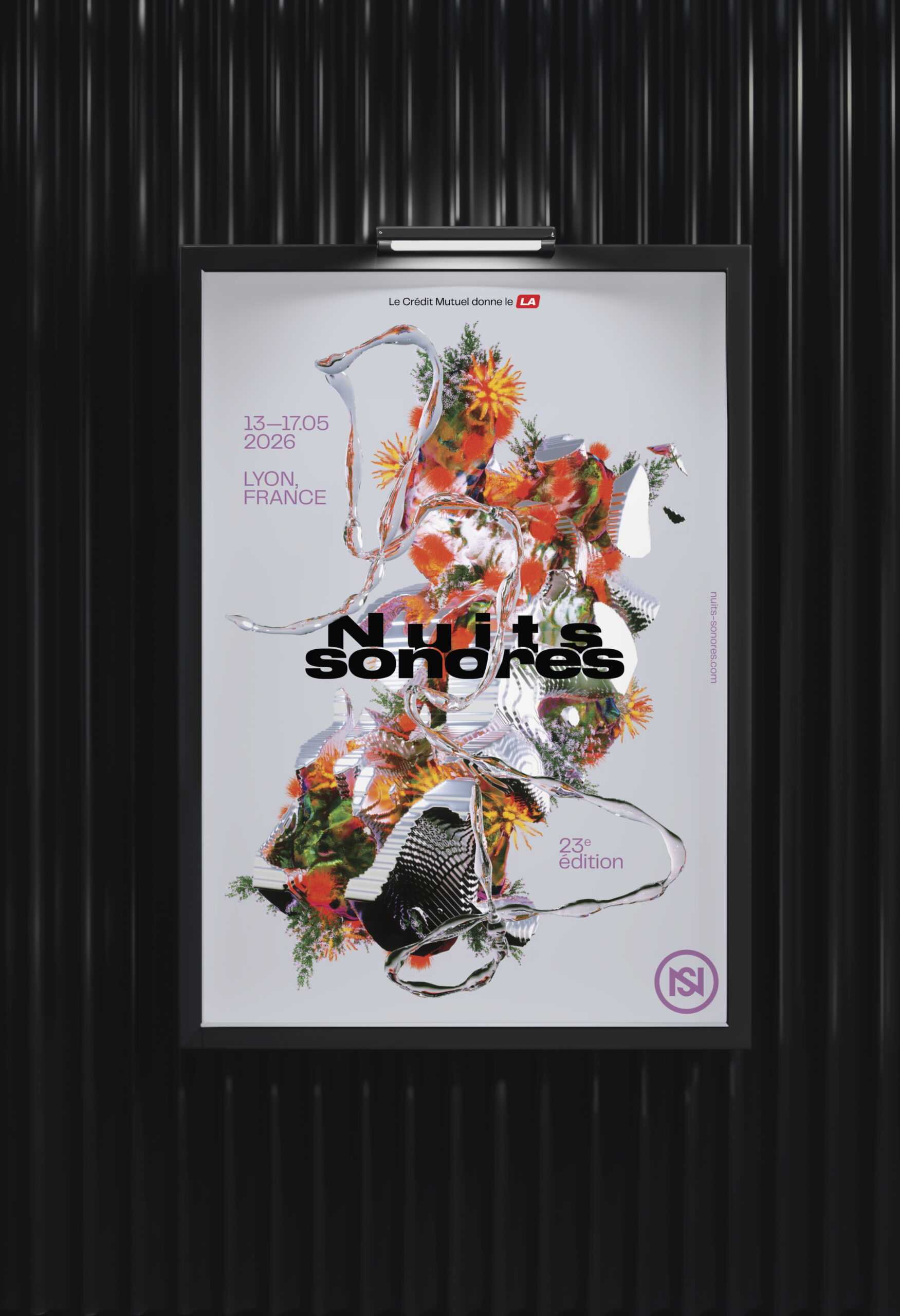
A three-dimensional poster, a first for Nuits sonores
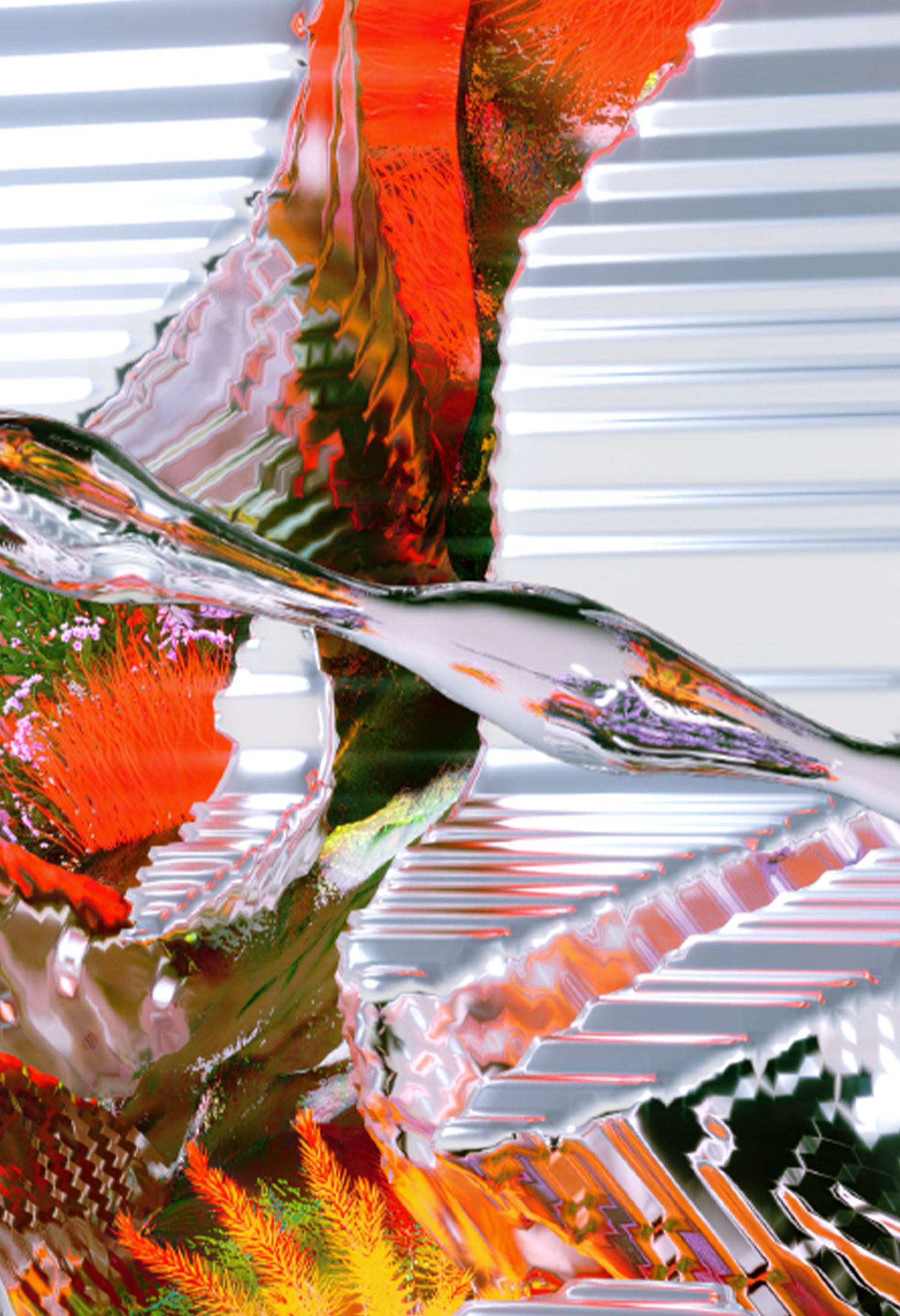
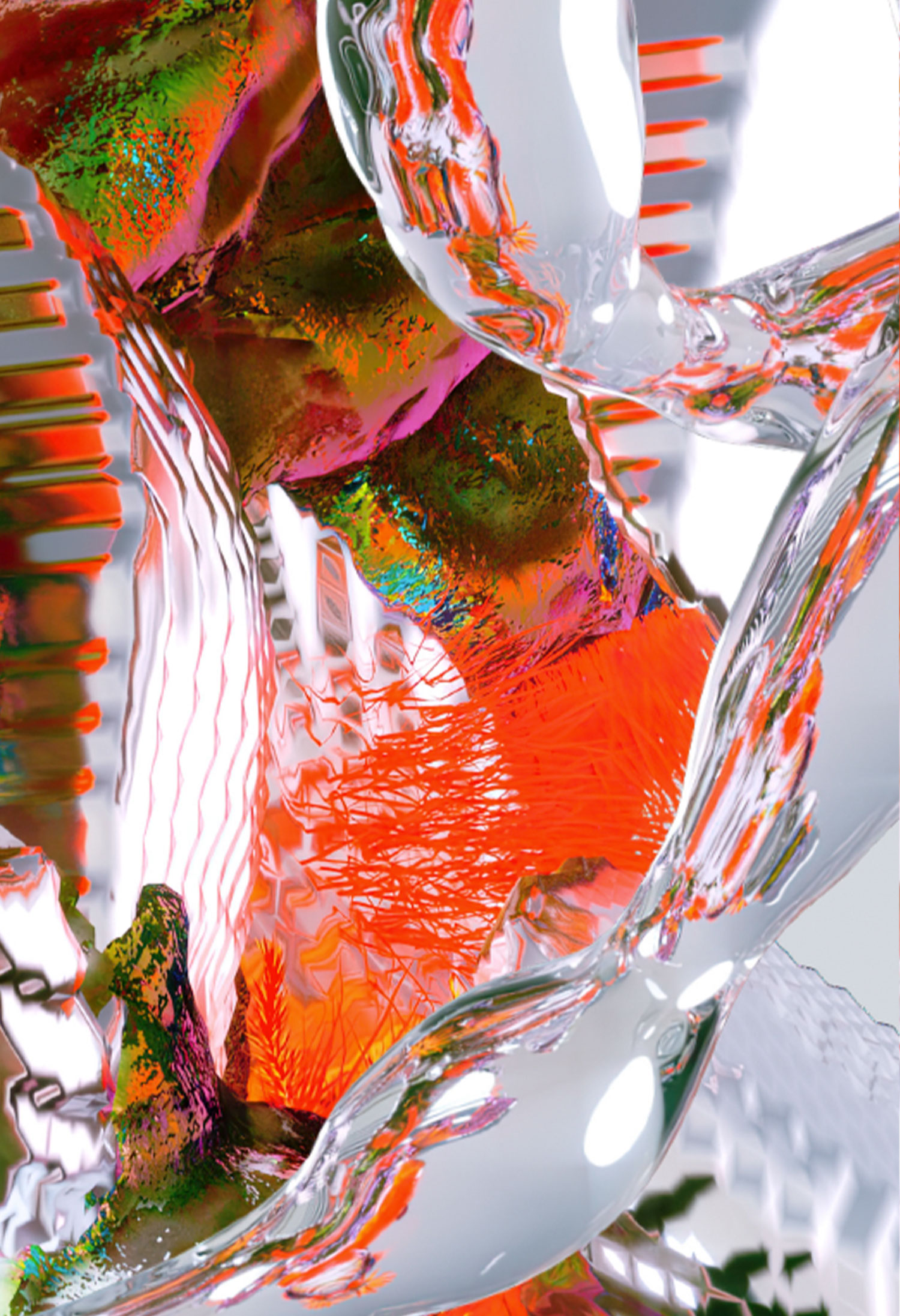
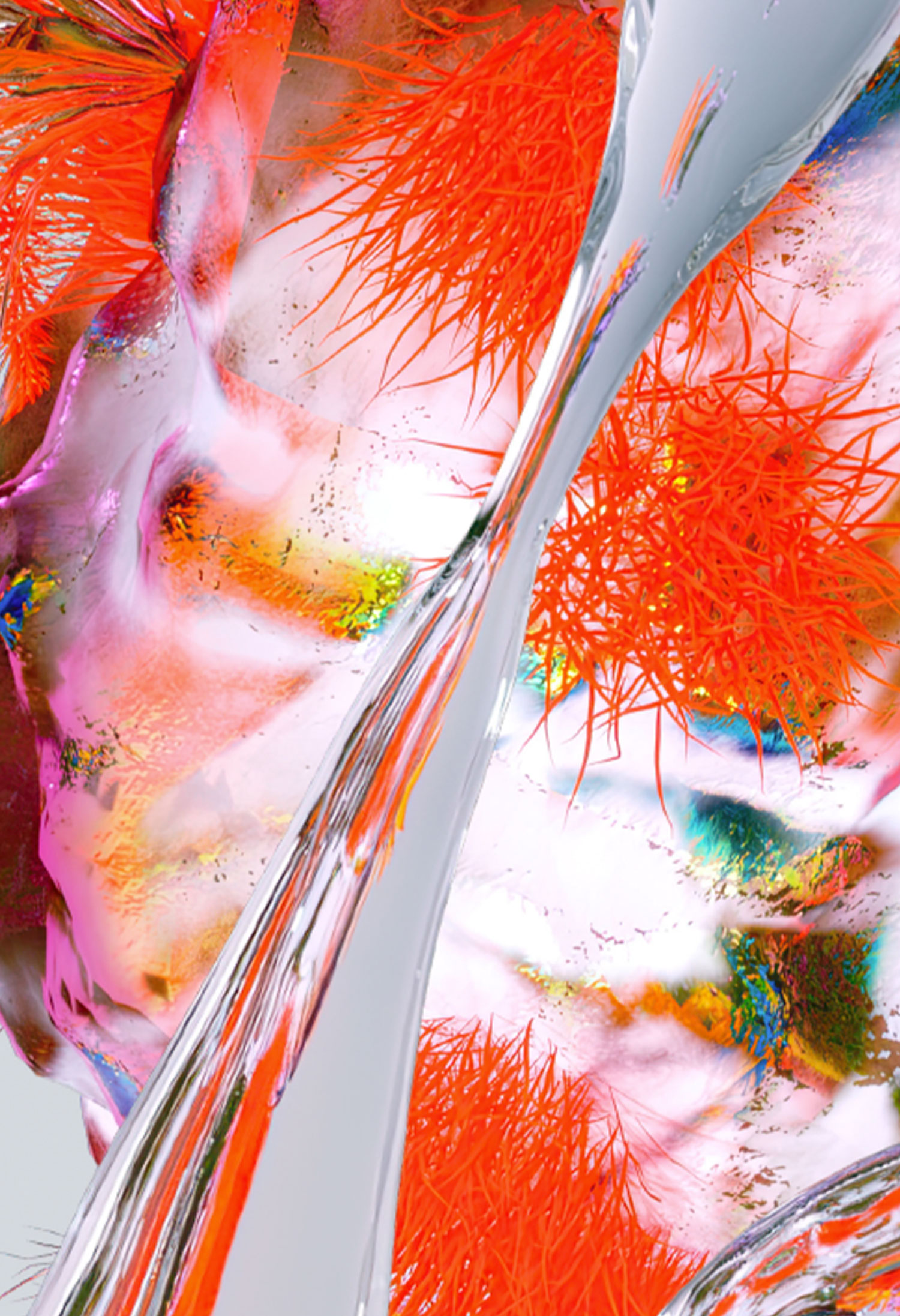
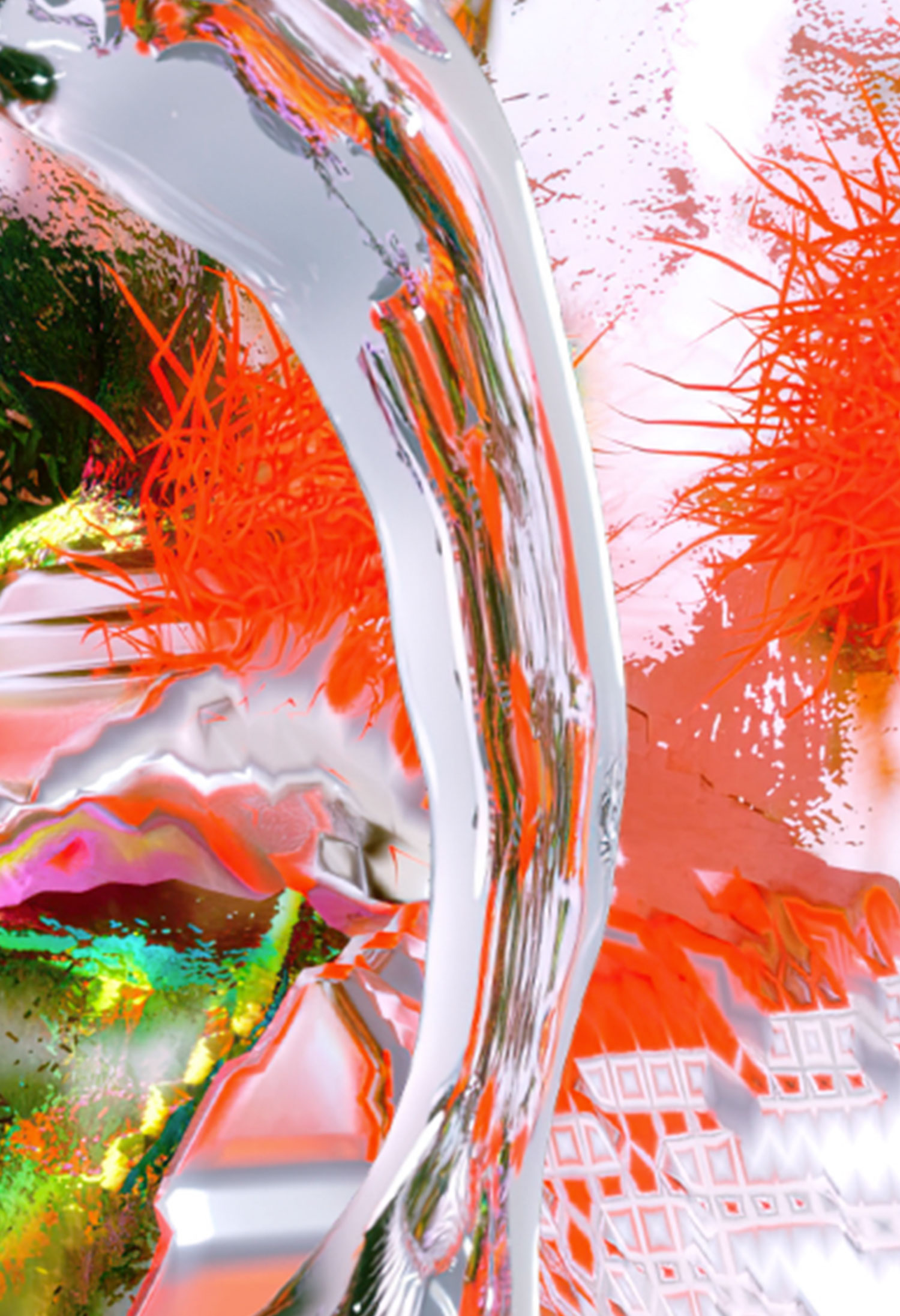
For this edition, Leeza imagined a fully-fledged universe, a physiological mirror of the festival and its symbolic renewal. It reveals a transparent fluidity evoking the Rhône and the Saône rivers, deconstructed metallic structures inspired by the hangars of Les Grandes Locos, and an organic—mineral and vegetal—nature that gradually reclaims the former industrial wasteland. A work that embodies the metamorphosis and creative energy of the festival.